
Table of Contents
The mother of modern education is the Vedas.
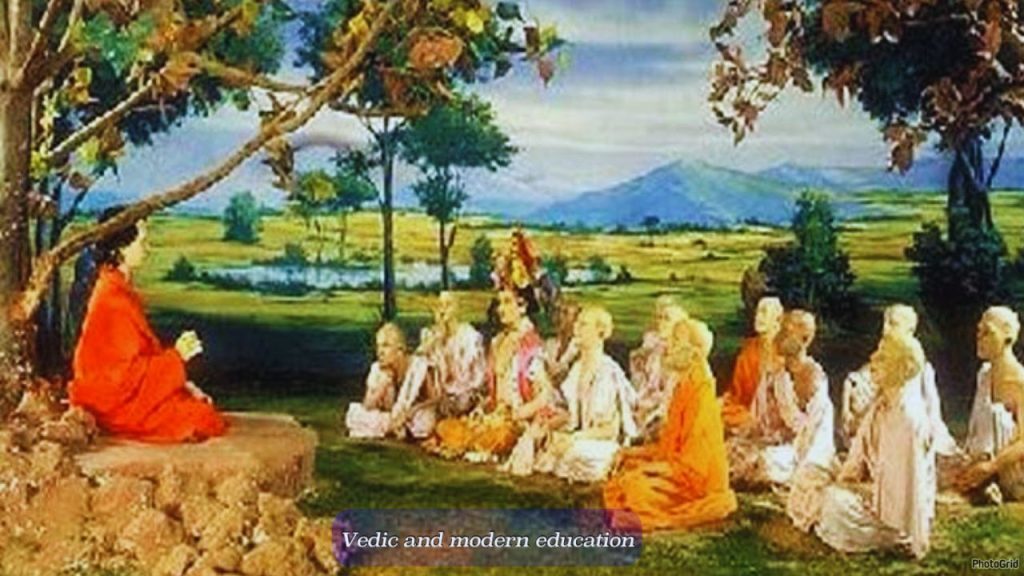
Education from the Vedic period to modern education. The creation of creation is unparalleled. The unique gift of this creation is the human race. Humans are considered a link in creation. Humans also have contact with other creatures. Humans in the wild state hunted for a livelihood and developed stone tools for protection. It was the thinking of that time and the need of the era.
Human Consciousness
When the tide of consciousness began to rise in man, and his needs began to increase, he began to focus his intelligence on the invention and use of new things. As a result of this, he developed an agricultural and animal husbandry society. This was the product of his experience and knowledge.
When mankind developed the agricultural era and started practicing it, he began to give priority to the importance of money, and the feudal era began.
Ordinary farmers began to be transformed into slaves. During the peak of the agricultural era, the scientific era emerged. While the feudal lords became the owners of industries and factories, ordinary farmers were transformed into workers. Writers, scientists, political scientists, economists, and philosophers were born in accordance with the era. Developed minds and philosophies have come from the knowledge and experience of their ancestors through generations.
Vedic Education
The Vedas are a repository of knowledge and experience acquired by mankind. Brahmins studied the laws and regulations of the Vedas and popular religious scriptures, while regional and royal kings studied military education, knowledge of the art of war, and knowledge of weapons, including archery. It is found that knowledge of weapons and the art of war was acquired for the administration and protection of the state. In fact.
This was a relatively new era at that time. If we talk about the Gurukul, the Gurus were like gods. If we look at it from the point of view of respect, the Guru was respected before the Gods and the King.
गुरुब्रह्म गुरुर्विष्णु गुरुदेवोमहेश्वरः
गुरु साक्षत परब्रह्म तस्मै श्री गरवेनमः
The Guru has been praised in this way – Guru is Brahma, Garu is Vishnu, Guru is Shiva, Guru is the witness of the Supreme Brahman. We pay heartfelt homage to such Gurus.
Puranic Education
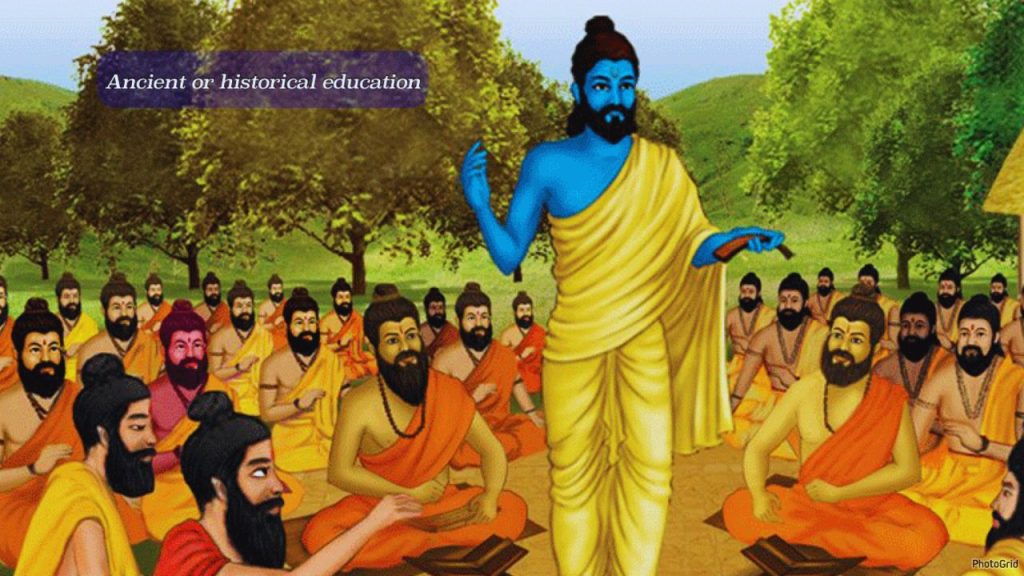
If we look at it chronologically, the Puranic period is considered after the Vedic period. The events of the Puranic period are recorded in the Puranas. Lord Shri Ram, Shri Krishna, Pandavas, and Kauravas received education in Gurukul. Disciples from various fields used to enter there to gain knowledge. Education was available not only in terms of caste but also in terms of ability and talent. Karna can be taken as an example of this.
Guru Parashuram, Dronacharya, Kripacharya, and Ashwatthama were famous figures in the art of war and weaponry despite being from the Brahmin clan.
The glory of education remains from age to age. The era changes, people’s thoughts and ideas change, but their thirst for education never quenches.
During this period too, the education system, like that of the Vedic period, continued. Brahmins used to learn about scriptures, and regional knowledge, and kings used to learn about weapons and the art of war. The knowledge of Ayurveda was widely used during the Ramayana period. There were also scholars of Ayurveda, like Susana, in the court of the King of Lanka, Ravana. During this time, there were also scholars who had knowledge of the science of medicine.
During this time, too, the Guru had a high position. The dignity of the Guru was respected in the underworld and by the gods. In the context of the story of the Mahabharata, Bhishma Pitamah had said, ‘If I could return to my childhood, I would have learned archery from Dronacharya.’ This statement confirms that Bhishma had shown high respect and honor towards
Guru Dronacharya. Therefore, in that era, the glory of education and the Guru was unparalleled. The main objective of education in the Vedic and Puranic periods was to establish an ideal citizen and an ideal society, which was relevant to the era. There is no doubt that this was the case.
Ancient or historical education
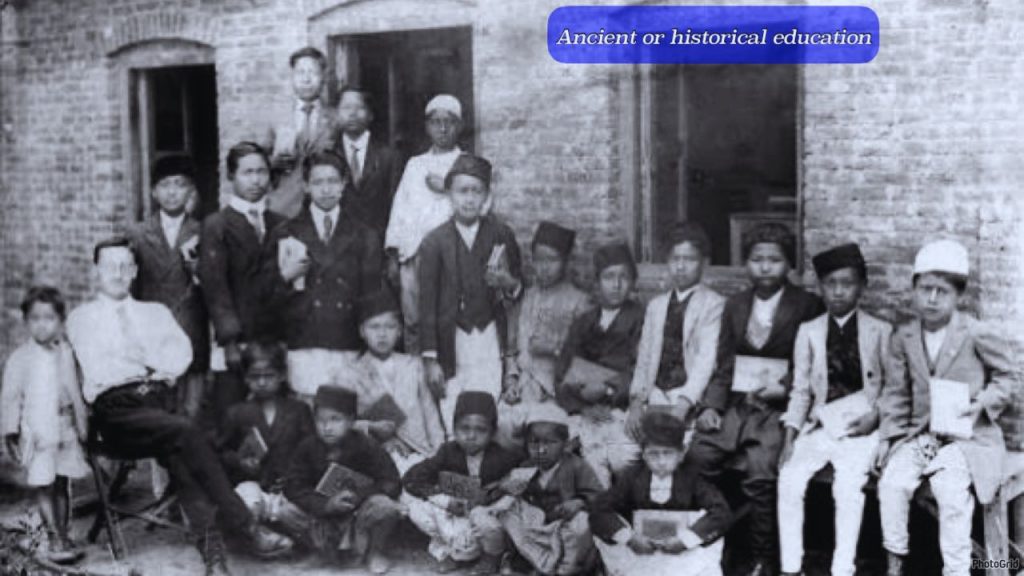
The glory of education has remained throughout the ages. The ages change, the thoughts and ideas of people change, but the thirst for education that they receive never ceases. Education, which has been going on since the Vedic and Puranic periods, has been going on at the same pace until the historical period.
If we talk about ancient Greece, the glory of education had blossomed there. Great philosophers like Socrates, Plato, and Aristotle had opened the gates of knowledge. Scientists like Copernicus and Galileo had introduced the reality of science to people who were immersed in the darkness of superstition. This was the demand of the era.
Education cannot be imposed on the people, and it cannot be counterproductive either. Civil laws had been formulated and implemented in ancient Rome. The idea that people should live by rules, dignity, and discipline had already developed in people, and later generations added bricks to it. Education is a matter of adding; if someone tries to cut, subtract, and give other new imaginary knowledge, it is a great mistake.
Many things had already been developed in the civilizations of Nilghanti and Babylon. The knowledge of murals, astrology, Ayurveda, handicrafts, and architecture had already come into practice. The Huangguo civilization was world-famous. The Chinese had already made a long leap in the field of knowledge and science.
They had already invented gunpowder at that time. If we consider these mentioned contexts, then the education of that time was contemporary, and it had already expanded the scope of knowledge everywhere. In ancient times, the real purpose of education was determined. At that time, the purpose of education was to develop the physical, mental, and social qualities of the learner and make him a worthy citizen.
If the Indus Valley Civilization is not discussed, the study of knowledge becomes incomplete and incomplete. The Indus Valley Civilization was a pioneer in the field of knowledge, science, and philosophy. The excavations of Mohenjo-Daro have made it clear how far ahead they were in agriculture and architecture.
The above-mentioned statements are not imagination; they are facts that have been shaped by reality. A question may naturally arise: who gave this knowledge, and where and how? Of course, the answer is easy. It was given by the knowledge guru, and this knowledge was given by great men who were refined by scholarship and experience in ashrams and gurukuls.
At that time, education was given in a way that addressed the needs of the state and the demands of the era. At that time, it was found that people other than caste-specific people received education according to their interests and abilities.
Ancient Education
In ancient times, the real purpose of education was determined. At that time, the purpose of education was to develop the physical, mental, and social qualities of the students and make them good citizens. At that time, education had developed greatly in India, including Nepal. Famous universities in India included Taxila, Vikramshila, and Nalanda.
Education was provided in these universities according to interest and need. There was no state interference in education. Since the gurus were entirely responsible to the state, the kings determined the policy and standards of education according to the advice of the gurus. The education of that time was contemporary, which met the needs of the state.
Ancient Education of Nepal
When raising the topic of ancient education in the context of Nepal, the fame of King Janak reached its peak in Janakpur (Mithila) of Nepal. King Janak was the Rajarshi. If we look at it from the perspective of historical chronology, human civilization had developed during the Kirat period. The Kirats were proficient in the art of warfare and archery. This society was especially focused on agriculture and hunting, although training in methods and arts was provided by the gurus.
The Lichchhavi period is considered a golden age from a historical perspective. Since the Lichchhavi came from Vaishali in India, they kept the traditional things intact and put the new experiences they brought into practical use. During this time, the Lichchhavi had given special importance to education and established a base called Agrahara for its development. King Mandev developed the system of keeping inscriptions and set a model in the field of architecture by building a palace called Mangriha. All this was the result of education.
If we look at the medieval education system of Nepal, there is diversity in the field of education. At that time, the Kathmandu Valley was the center of education. Especially, the influence of Buddhist education was strong here.
Similarly, the time of King Anshuvarma was also a golden age for education. He wrote a book called Shabdaviya. He exhibited models in the field of architecture. The Kailashkut building is considered a model of this period. The Sanskrit language was used more during this period. King Narendradev was a connoisseur of art. During this time, the centers of education were Rajkul, Gurukul, and Vihar. The monasteries provided knowledge on tantra, sculpture, metalwork, woodwork, music, and book writing. This confirms that the purpose of ancient Nepalese education was focused on the development of spiritualism and practical education, which was the education that that era desired, which was relevant to the time.
Medieval Education of Nepal
If we look at the medieval education system of Nepal, we find diversity in the field of education. At that time, the Kathmandu Valley was the center of education. Especially, the influence of Buddhist education was greater here. Buddhist education was more attractive in the monasteries of Kathmandu and Patan. In addition to knowledge-centered education, practical education was provided in the monasteries.
During this period, in addition to the theoretical knowledge of Buddhist education, knowledge of tantra, craft, ritual, sculpture, metalwork, stone art, architecture, music, as well as vocational education was provided. Due to the influence of this knowledge, the great artist Araniko was able to spread his talent in Tibet and China. With the knowledge of this craft education, today the Kathmandu Valley is presenting a unique model of civilization and culture.
On the other hand, through Sanskrit education, Gurukul education was running at a fast pace in the ashrams. Caste, class, and family professions had become practical by taking education according to the times. Jayasthiti Malla had arranged a Guthi to take care of educational centers for the development of education. King Pratap Malla was a king himself. He knew 15 languages. He had given high priority to Buddhist education and Vedic education.
Modern education in Nepal
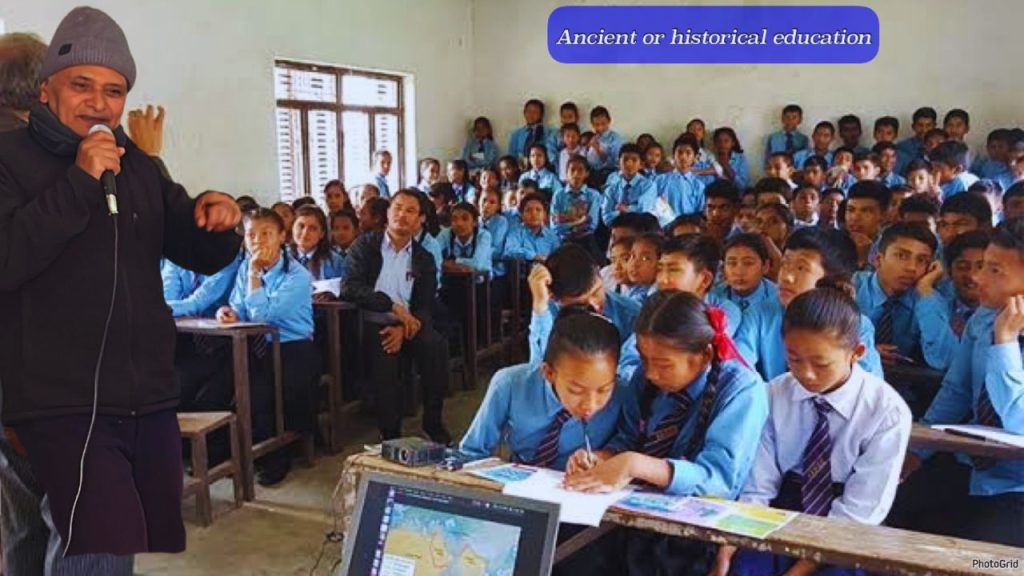
Modern Nepal and the Education System
Even after King Prithvi Narayan Shah of Gorkha completely conquered the Kathmandu Valley in 1826, there was no change in the traditional education system. At that time, the Gorkha kingdom had established monasteries in the northern Himalayan region of Gorkha for the development of Buddhist education. Emphasis was placed on the development of Buddhist education by arranging Birta and Guthi.
Education continued to be passed down through generations in Gurukuls and Brahmin clans. During wartime, people between the ages of 12 and 70 in Gorkha had to participate in the war. During this time, weapons and martial arts were taught. The belief that education should be relevant to the times seems to have gained traction in Gorkha.
Since the Gorkha kingdom was often immersed in war since its establishment, no new system of education could be developed except for traditional education. After Prithvi Narayan Shah’s unification campaign was launched, since the Gorkhas were focused on war, no work was done to open any schools and provide education, but military education was made mandatory in Gorkha.
During the war, people from the ages of 12 to 70 in Gorkha had to participate in the war. During this time, weapons and martial arts were taught. If a soldier achieved heroism, the Gorkha court would provide his sons with military training and support until they could use a lance, sword, and khukuri.
The basic point that emerges from this is that since the state was engaged in war for the unification of the state, it should be considered appropriate for the state to adopt this type of education system. This process continued until the Nepal-British War. In addition, Prithvi Narayan is said to have encouraged those who were interested to study Sanskrit and Persian.
The Rana period and modern education
The Rana regime was a kind of paramilitary system. During this period, it was a crime in the eyes of the ruler for citizens to read and learn. After Jung Bahadur traveled to Britain, the establishment of Durbar High School proved to be a milestone.
Modern education began from here. Jung Bahadur seems to have started a modern education system, keeping in mind the changing era. Chandra Shumsher had established Shrestha Pathshala to carry out the general work of administration. The establishment of Tri-Chandra College was an obligation for Chandra Shumsher.
The revolution of 2007 BS was also a gift of education. After the end of the Rana regime, the then governments emphasized education, but it was not systematic. The work of systematizing education was done by the National Education System Act of 2028. After King Birendra made primary education compulsory in 2031, there was a tide of education in every village.
A question has been raised here regarding the difference between the new education system and the old education system. The old education system fulfilled the needs of the state by providing education that is relevant to the era and making it professional. The new education system led the era, but the modernization of industry, commerce, and agriculture could not keep up with the pace of education, which led to an increase in the number of educational unemployment.
Education has been making strides in line with the era, but due to the lack of infrastructure development and modernization in the country, it is now unable to bear the burden of educational unemployment. Education has played a major role in the transition of man from the Stone Age to today’s satellite age, but where are we in the context of Nepal?
After the change in 2046 BS, the neoliberal ideology became dominant in Nepal.
The influence of this ideology spread to all sectors of the economy. Private sector investment in education became widespread. As a result, community schools and community campuses became scarce. Areas that were under the responsibility of the state fell into the hands of profit-seekers, and the common people were far from its reach.
Although the constitution states that the state is socialist-oriented, how much of it has been implemented in practice? Although secondary education is compulsory, students in community schools have to pay fees for grades 11 and 12. After the introduction of the semester system in universities, working-class students who aspire to higher education have been deprived of the opportunity to study.
The world has now become one country. This means that the world has been gripped by globalization. Its impact has been felt by poor and resource-poor countries. After the economic influence took root in education, the principles of trade, interest, investment, and profit were considered as tools for economic development. After the introduction of the liberal era, the means of earning income for individuals were relaxed.
Economists like Adam Smith, Thomas Robert Malthus, David Ricardo, John Stuart Mill, and Jeremy Bentham, who said that ‘education should be commercialized and kept out of the hands of the state,’ gained recognition, which led to millions of students in Western countries being deprived of education. Instead of developing intellectual capacity alongside service, the state began to use education as a tool for profit.
This belief has spread, and today, education is considered a business sector. The concept that foreign investment should be invested in it has been promoted. Foreign grants have made education dependent and over-dependent on originality.
International workers and cheap laborers have been produced as the donors want. It is clear that the destination of over-dependent education, which has put an end to originality-based education, is brain drain.
Conclusion
Education has played a significant role in bringing people from the Stone Age to today’s satellite age, but where are we in the context of Nepal? Education that can compete in the global market by absorbing the positive aspects of the global environment and preserving the original aspects is the need of the day. Our schools and universities should not become factories that produce foreign workers and cheap labor. Stakeholders must focus on this.