
Education is the backbone of the country. It is the responsibility of the government to provide quality education to all its citizens.
Table of Contents
Weak government education policy
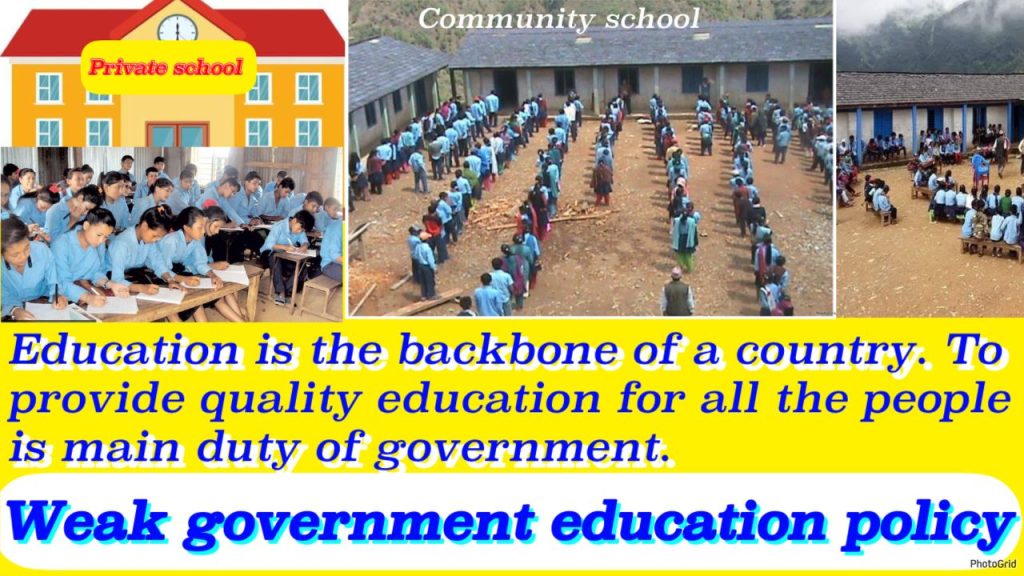
Education is very important for human life. Governments of all countries in the world are fully responsible for providing education to their people. In the context of Nepal, government schools started opening only after 1950. King Mahendra made a national education plan, and King Birendra implemented it. The primary level was free, and the fees were low from 6th to 10th grade. There was a system of scholarships for the poor and the meritorious. The education system was popular.
Decline in government education
After 1989, when a multi-party political system was introduced in the country, the number of private schools increased rapidly, and the number and quality of government schools began to decline.
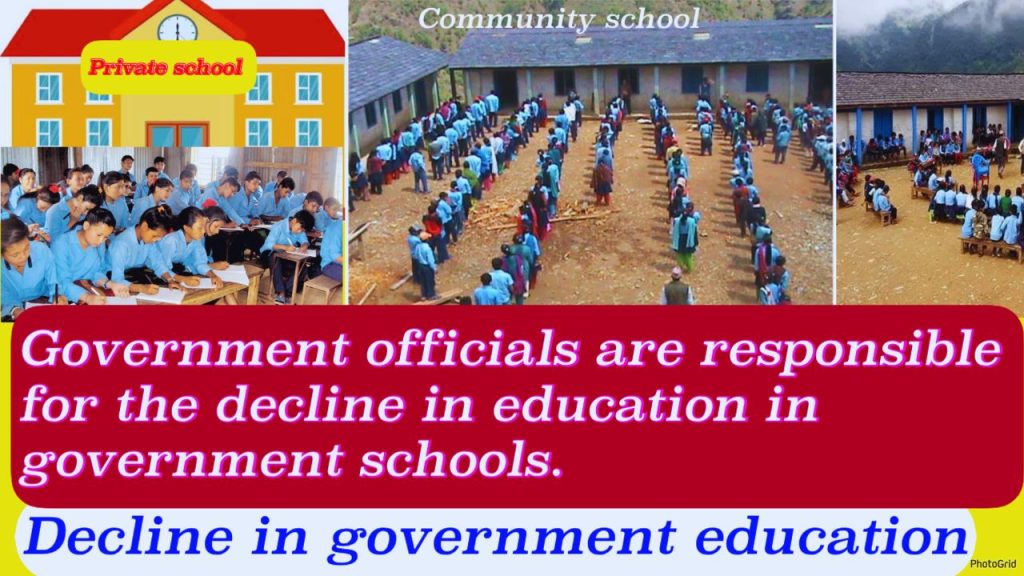
Backers of the private schools
Decision-making leaders, administrators, and educationists in the state apparatus are somehow connected to private schools. Many education administrators have become directors and advisors of private schools. Those who are only interested in improving public schools have enrolled their own children in private schools. It is clear that they are only pretending to run private schools and are working hard to improve government schools.
Teaching in a Government school or a private school?
Community school teachers themselves take their children through the gates of private schools and leave for government schools for jobs. And what do they do when community schools dry up and private schools do not? It seems that the elements of the state apparatus are directly and indirectly involved in supporting private schools. It is natural for everyone to want to provide quality education to their parents and children from quality schools.
Discrimination in teacher licenses
Since 2059, a legal provision has been made to make it mandatory to have a license to become a teacher. Those who have studied science but have not studied education are not allowed to get a license. But private schools do, even if they do not have a license. Private schools continue to get teachers, while government schools do not. Teacher training, licenses, minimum qualification for teachers, and salary according to qualification in private schools is less than in government schools, even today, the crowd is there.
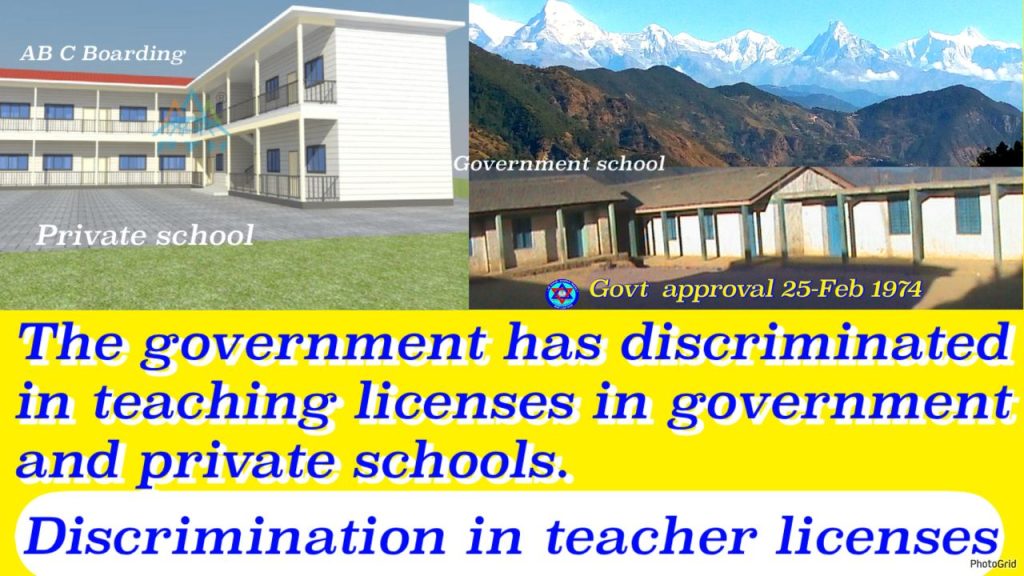
The contribution of such schools to increasing the educational index is at the forefront. In Nepal, the concept of two types of schools, community and institutional, has been put forward as educational institutions at the school level. Section (D 3) of the Education Act 2028 (Ninth Amendment 2074) defines institutional schools as “schools that have received permission or approval from the Government of Nepal without receiving regular grants.
The said Act has defined community schools as schools that have received permission or approval from the Government of Nepal without receiving regular grants. The definition of the Act itself also implies that institutional schools do not receive government grants or other financial assistance, but the government gives permission or approval.
Since the schools established in this way are naturally registered and operated privately by individuals, partnerships, or companies, such schools are automatically seen as private schools. Whether the establishment of private schools is a personal desire or a government requirement has not been established to date. It is not heard/found that the government has requested anyone to open private schools or called for applications. However, the contribution of such schools in the educational development of Nepal is at the forefront. The contribution of these schools should be considered important in the current literacy rate of more than 70 percent. So far, 47 districts have been declared literate districts, and the contribution of private schools is no less important for this.
Not only this, considering whether private schools will be abolished or not, will community schools be able to cope with the pressure of students who went to private schools? It is impossible to even imagine. Overall, more than 25 percent of students are still studying in private schools. In other words, education for all is not possible in this situation without the concept of private schools. Such schools have helped reduce the pressure on government schools by enrolling more than half of the students in the city market.
Loose regulation
Every commission formed after the political change in 2046 BS ( 1989) has been recommending the demolition of government schools. The National Education Commission, formed in 2047 BS( 1990 ), introduced the concept of private schools that anyone can open and classes 11 and 12 (10 plus 2). Now, it was said that one can study up to class 12 in the village instead of going to the city to study on campus. People were eager to open higher secondary schools. The state did not take any financial responsibility.
When the school itself had to shoulder the entire responsibility of teaching, the parents were left in a state of shock. With the policy of removing the certificate level from the university, private higher secondary schools sprang up all over the city. Education turned into a business. There was little monitoring at the state level.
After the High-Level National Education Commission 2055 and the report of the High-Level Working Committee on Education 2058, a policy of transferring schools to the community was also introduced with the help of the World Bank. Permanent approval was stopped for government schools with additional classes. The proposed schools were handed over to the community after being lured by a small grant and a few relief posts. The state tried to evade its responsibility here, too. On the other hand, private schools got a chance to flourish. In the case of such schools, there was no special monitoring, minimum conditions, or basic standards that the schools had to follow.
Conclusion
Education is the soul of a person. An uneducated person is like an animal. It is the government’s job to make education accessible to all the people within the state. I would like to say with a sad heart that the slogan “Education for All” that was started in Nepal during the reign of Kings Mahendra and Birendra was abandoned after the advent of multi-party politics. The time has come for all Nepali people to become aware and re-establish educational facilities
Next post: Quality Education