
The word “education” is a Sanskrit word derived from the root “शिक्षा”. Which means “to teach”. Education is the process of imparting knowledge of a subject or teaching a person a skill, quality or behavior. Education is called ‘Education’ in English. “Education” is believed to have come from the Latin word Educatus or Educare.
Education is the process of bringing out and gradually developing the hidden potential in a person.
Table of Contents
Education is the development of the potential in a person, learning to become a competent and capable citizen and developing good character by acquiring knowledge and skills.
The real meaning of education is to develop all aspects of a person’s intellectual, physical, social, economic, material, moral etc. or the all-round development of a person. It is a system of learning and teaching knowledge and skills. Education takes people from darkness to light. Education is a continuous process.
In the article “The Origin and Meaning of Education”, I have briefly discussed the origin of education, its definition, and the educational policies and practices of the ancient era, as well as the state of education in the Middle Ages, as well as the subject of initiation.
Some popular definitions of education
- Education is that which helps a man to become Selfless and kind – ऋग्वेदRigveda
- Education is nothing but the formation of habits – Rousseau
- Self-realization is education – Shankaracharya
- There is nothing purer on earth than knowledge – Bhagavad Gita
- Education is the bringing to light of that universal idea of the world that exists invisibly in the mind of every person – Socrates
- Education is the natural, all-round and progressive development of the inner power of man – Pestalozzi
- Education is the most powerful weapon with which you can change the world-Nelson Mandela
Sanskrit is the mother of languages -भाषाणां जननी संस्कृत-
Language is an essential element for education and learning. Sanskrit is the oldest language in the world and its script is Devanagari. ऋग्वेद The Rigveda, the oldest book in the world, is also written in Sanskrit. Many Nepali, Indian, and other languages are based on Sanskrit. Therefore, Sanskrit is called the mother of languages.
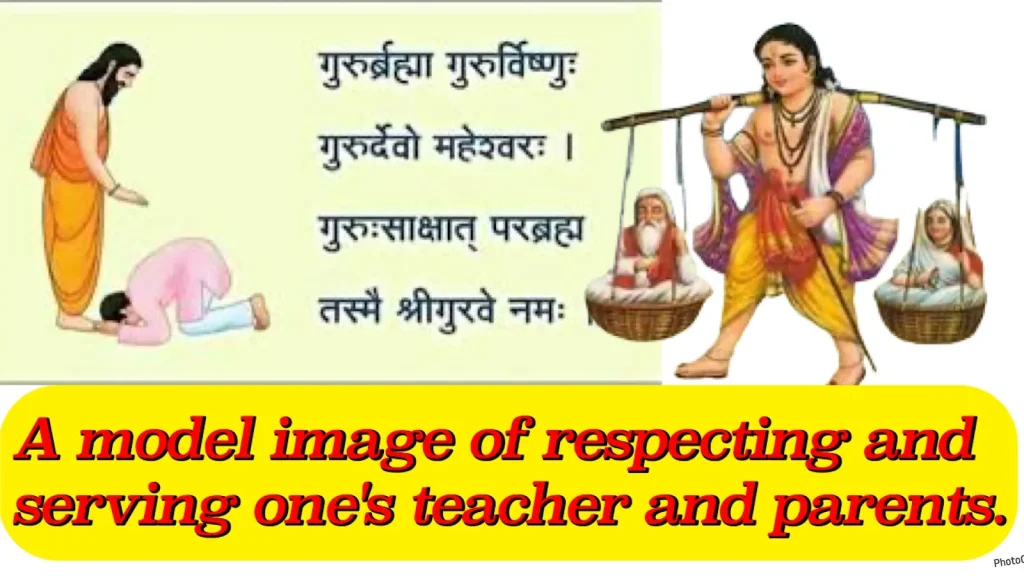
In ancient times, it was customary to acquire education in the presence of the guru in a gurukulam (guru’s ashram). All students had to strictly follow the guru’s orders, instructions, and rules. In the Guru Kul (teacher’s residence), spiritual, religious and moral teachings and studies were held.
Lessons such as serving one’s parents, hospitality, donation, helping, and doing good to the poor and suffering people were taught. Verses like these ोwere meditated upon – Respect and serve, respect and worship mother, father, and Guru as gods.
मातृ देवो भवः पितृ देवो भवः गुरु दवो भवः
Dikshya grahan “दीक्षा ग्रहण “
‘Dikshya’ is the completion of the education learned and known by sitting close to the Guru. Education destroys the darkness and ignorance of our lives and develops our consciousness, but Dikshya shows us the path to achieve our goal. It is said that we can continuously receive education based on books, scriptures, family, society and experience, but to receive ‘Diksha’ or to be oriented towards the goal is possible only through the inspiration, teachings and guidance of a guide, Sadguru, or a great man.
For example, King Prithvi Narayan Shah had unlimited strength and enthusiasm, but the unification of the Kingdom of Nepal was possible only through the wisdom of Bise Nagarchi. Similarly, Swami Vivekananda had a vast ocean of modern and material knowledge, i.e. a vast storehouse, but only through the ‘Dikshya’ given by Swami Ramakrishna was he able to determine a new goal in life.

Education in the Middle Ages
In the Middle Ages, Nepal’s education system began to be taught in institutions such as Gurukul, Temples, Gumbas, Guthi, etc. Education was improved a little compared to the ancient era. Lessons such as useful life skills, art skills, meditation, yoga, respect for parents and service were taught.
In the Middle Ages, in addition to spiritual and life-useful skills, tantra was also included. In the education of that time, how to respect and address one’s elders, how to develop morally, how to behave, how to serve one’s parents and teachers, welcoming one’s relatives as the deity of the house, and the feeling that the people of the world are one, everyone should be loved, and doing good to others is religion were developed.
World peace was prayed for daily. Positive thinking was developed from morning prayers. Truth, loyalty, ideals, harmony, tolerance and morality were indispensable qualities in a person. Honesty was considered the true quality of society. Following the rules, demonstrating good behavior and observing discipline were given prime importance.
Restraint, self-confidence, self-reflection, and self-analysis were used to establish a conscience that could distinguish right from wrong. The aim of providing and receiving education was to prepare citizens who could face difficult situations such as those that would arise in the future in order to live in human life and human society.
A kind of educational awakening was created by acquiring knowledge of intellectual discussion, logic, writing skills, spiritual science, astronomy, architecture, Ayurveda, music, fine arts (literature, music, painting, sculpture, architecture) and civilized language.
On the whole, religious, classical and practical education was provided. Knowledge, skills, attitudes and inherent talents were developed. Children are developed as people who analyze the past, adapt to the present and see the future. At that time, gurukuls, monasteries, viharas, and monasteries were the educational centers. In recent times, vocational groups were divided and vocational education was provided through Guthis. After unification, it is known that military education was given to the children of soldiers.
Conclusion on Origin and meaning of education
In this article, I have mentioned the origin, meaning, and definition of education in the previous paragraphs. What was education like in ancient times? It is about how initiation was taken after the completion of education. And I have included information on how changes have been taking place in education.
READ MORE: Importance of Yoga for a Better Life