
Table of Contents
Meaning of Meditation
Meditation is such a miraculous thing that its practice makes the student’s brain clean and strong. The main way to make the human brain healthy and strong is through yoga and meditation. Main types of meditation: Breathing meditation, mindfulness meditation, mantra meditation, tratak meditation, and love. Meditation, compassion meditation. We have read the history of how great sages in ancient times made their brains healthy and strong by practicing yoga and meditation.
In the modern era, deep study and research is being done all over the world on the subject of yoga and meditation. Research has also proven it, and the whole world is getting attracted to it.
Scientific study of meditation
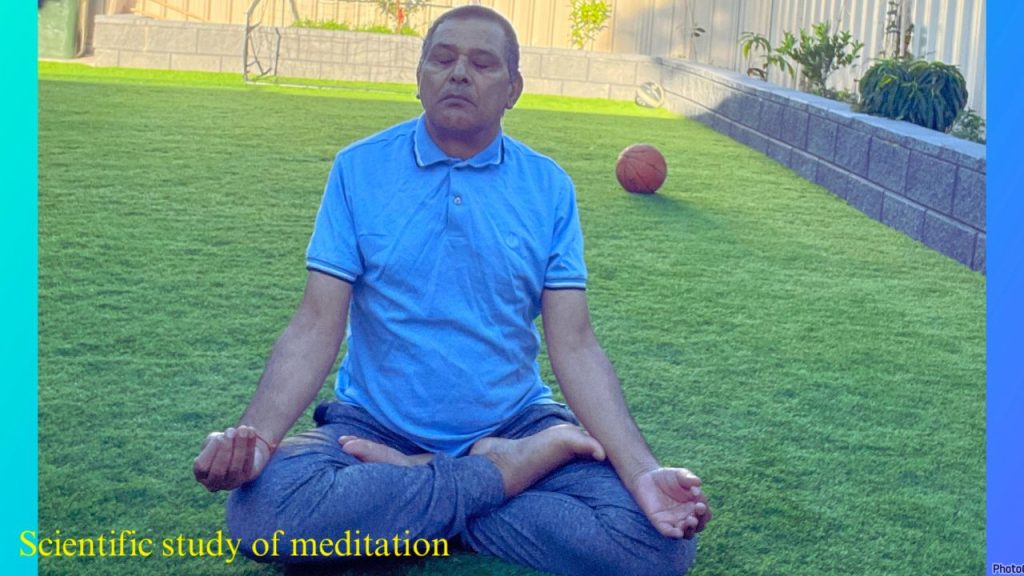
Meditation means to focus the mind deeply on an object. Meditation means concentrating on anything. A miraculous science is born when knowledge and meditation are mixed. Nepal is considered the birthplace of meditation. It is a spiritual science created by Shiva along with the creation of mankind. Maharishi Patanjali organized it for the benefit of the human community. Historical evidence suggests that many sages have achieved success through meditation.
When researching meditation studies and practices in various countries, it seems that the meaning and importance of meditation in daily life are very profound. The Japanese word Zen and the Chinese word Chan are corruptions of meditation. In English, meditation is also called meditation. No matter how meditation is addressed, its main meaning is awareness, public consciousness, witnessing, and seeing. Yoga has various limbs.
The eighth limb is meditation. Meditation is the only element that people use as a method of spontaneous healing. This rule does not apply to other parts of yoga. According to Vaigik philosophy, Nepalese and Indian people who have been studying and practicing deeply conclude that every student must practice meditation. The Ashtanga Yoga philosophy, written by the great sage Patanjali, is an example.
Scientific expansion of meditation for students
Meditation, which has been practiced especially in Nepal and India since ancient times, is currently being studied in universities /research centers in countries such as Britain, America, Germany, Canada, the Netherlands, Australia, Japan, China, Switzerland, etc. Scientific results have generally shown that stress, anxiety, and depression are reduced, attention/memory and self-control are increased, and changes occur in the structure and function of the brain.
However, the effects are not always great, and some people have also reported negative effects. It can be assumed that these are due to a lack of proper and appropriate practice skills. It is necessary to do it based on the methods and formulas of Vedic principles and the great sage Patanjali. Meditation should be mandatory for students. It is better to make short, medium, and long-term meditation classes and practice them. Students with different brains get the opportunity to participate in different classes and can be successful.
Countries or study centers conducting meditation research
Currently, MBSR meditation research is actively being conducted at Massachusetts General Hospital, Harvard (Lazar Lab), Brown University, and many other universities in the US.
Psychological clinical studies and research are being conducted at the University of Oxford (Oxford Mindfulness Research Centre) and other universities in the UK, in which students and researchers from all over the world participate.
In India, research on yoga-nidra and special meditation, as well as neuroimaging and clinical studies, is being conducted at IITs, AIIMS, and many other study centers. In Germany, Max Planck and other institutions are conducting special studies on biological measurements of cortisol, hematocortisone, etc. and the effect on stress. The results have also shown that meditation is beneficial from student life to the last stage of life.
Psychological, neuroscience, and public health studies are also being actively conducted in Canada, the Netherlands, Sweden, Austria, Japan, China, etc.
What are the scientific results?
Regular practice of meditation and yoga improves stress and physiological markers: Regular practice can reduce long-term stress-hormone cortisol/cortisone. Some studies have shown improvements in practitioners who meditated regularly for 3 to 12 months for half an hour.

Improvement in mental health: Many RCTs, randomized controlled trials, and meta-analyses have shown improvements in anxiety, mild to moderate depression, and overall well-being.
Brain and structural and functional changes: Courses such as MBSR have been reported to change gray matter density/structure in the hippocampus and other areas. That is, experience-dependent brain plasticity fMRI studies have shown evidence of functional connectivity changes depending on the type of meditation and the way of regularity of practice.
Meditation increases the ability to focus: Regular and methodical meditation practice increases the ability to focus and emotional regulation of students to study any subject. Overall, the results of tests show that those who meditate have improved information processing and reduced distraction. Therefore, meditation is very important for students.
Rules and precautions for meditation
Meditation is very important and beneficial for students. But some precautions must also be taken. Meditation is not only beneficial, but sometimes it can also cause harm if done contrary to the method and method. Rules to be followed while practicing meditation: Purity in diet – fresh, pure and vegetarian food, small quantity of food, if you are a non-vegetarian, then you should eat only a little meat and a lot of vegetables, fruits, milk, etc.

Suitable time – The time and environment for meditation must be suitable for the student. Brahma Muhurta (from 1:30 am to sunrise) is the best time for meditation. If you do not get a chance to do it during this time, it is better to meditate in a quiet, noise-free, and pollution-free time.
Clean stomach: Meditation cannot be effective if you are suffering from constipation. Therefore, the best time for meditation for students is in the morning, Brahma Muhurta, after defecating, taking a bath, and meditating. This time is best for all seekers, not just students.
Suitable company: If there are other friends who meditate, it is important to be calm and disciplined. Suitable instructions: Advice or instructions for meditation should be good; if the rules and regulations are not followed properly, meditation cannot give good results. Therefore, let us follow the rules and regulations and gain benefits by meditating. I would like to advise everyone to be aware and meditate according to the rules and regulations.
Conclusion
Meditation is a mental practice that focuses the mind, calms it down, and makes it aware. Meditation teaches you to be fully present in the present moment, reduces mental unrest, reduces stress, anxiety, and fear, increases mental clarity and self-awareness, maintains emotional balance, and increases the ability to experience spiritual and inner peace. However, meditation without following the rules and regulations is not fruitful, so let me briefly say a few words about the method and precautions of meditation.
Sit in a quiet place, focus on deep breathing, and simply observe the thoughts that arise in your mind without trying to stop them. Chant a rosary, mantra, om, or concentrate on your breath. Benefits: Reduces stress, tension, and depression. Improves concentration, memory, and learning. Helps with blood pressure, sleep, and mood control. Increases self-confidence, patience, and positive thinking. You can control your emotions and behavior