
Table of Contents
Philosophy is a special perspective
Philosophy is also a perspective on things or life. It explains human life. It observes various aspects of the world. It examines and appreciates nature, as well as creates a concept of conservation. Not only about human life and the world, philosophy also determines human behavior and molds it into culture. It creates culture and establishes standards. It tries to make it relevant to the time.
It tries to make it sophisticated. It can be a means of finding a way to see the future through the combination of the past and the present, for students in families, communities, societies, and schools to learn and for teachers to teach, and for parents to set a path for life guidance for their children. It helps to prove the path. In this article, I want to explain and analyze the views of various philosophers, especially within the philosophy of education.
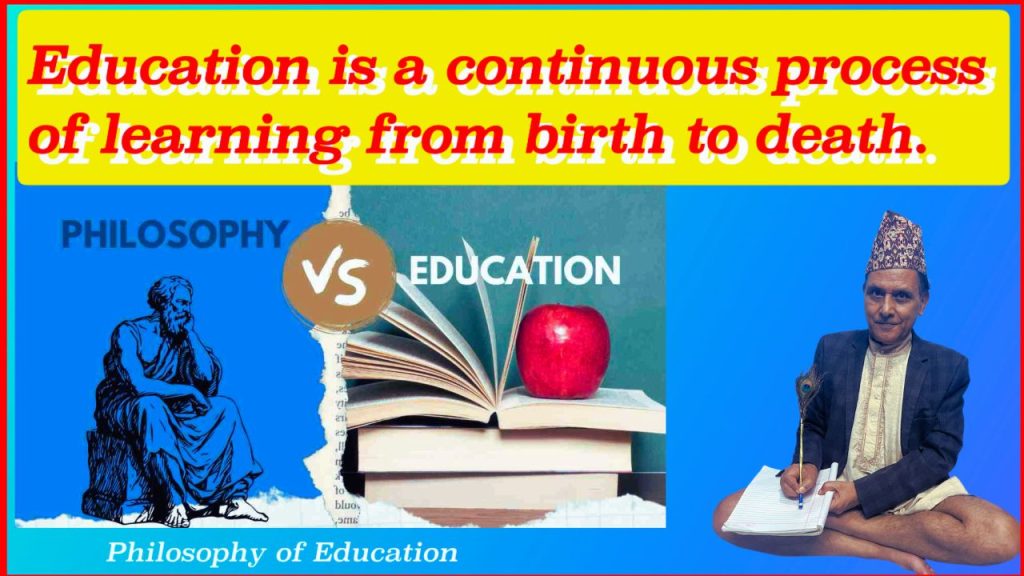
Based on my 42 years of teaching experience and research, I would like to define Education is the filling of the human mind with the light of knowledge and wisdom. The qualities of kindness, love, affection, compassion, helpfulness, altruism, patience, peace, etc., in the mind of a person who has received true education remain constant. Therefore, he/she is called an ideal person in society and lives a life full of happiness and peace.
Meaning of education
Education is the entry of light in the form of knowledge into the dark brain. Learning or giving knowledge on any subject is also called education. No age, caste, gender, religion, or culture can stop one from acquiring education.
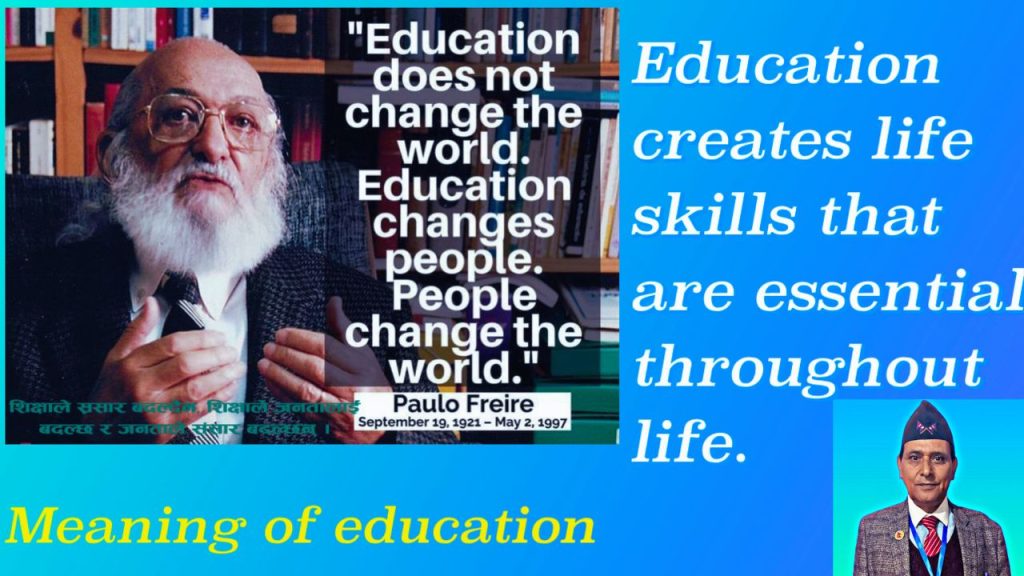
People are acquiring education from birth to the end of No one has ever been fully educated. If there were no education, this world would have been echoing in darkness. Education inspires people to follow the right path. Education and learning continue throughout life.
Education is necessary to improve not only an individual but also society, community, and nation. Education is necessary to create a good person, a good family, a good society, a good community, and a good nation. Various sayings of some scholars about education help guide life on the right path.
Different educational systems in the world are based on different educational philosophies. The most famous and ancient educational philosophies are considered to be Vedic philosophy and Buddhaqq philosophy. Some philosophers also emerged in Western countries, and their philosophies are also being used. I would like to name some world-famous educational philosophers. Ancient thinkers like Plato, Socrates, and Aristotle are famous for their philosophies. Enlightenment figures like John Locke and Jean-Jacques Rousseau, and modern theorists like John Dewey and Paulo Freire are included. These world-famous philosophers contributed many different ideas about the purpose of education, from the development of innate abilities and virtuous citizens to promoting social transformation and practical, experience-based learning.
Some motivational sayings
1. If you keep learning and education interested, no one can stop you from moving forward. Anthony J. DeAngelo
2. Education is a passport to the future. Those who do good today will have a good future.
Malcolm
3. Education is such a powerful weapon, with the use of which we can change the world.
Nelson Mandela.
4. The roots of education are bitter, but the fruit is the sweetest. Aristotle.
5. Education is not preparation for life; education is life itself. John Dewey.
6. I have no special abilities. I am just eager to learn and understand new things.
Albert Einstein.
7. Do not try to give your child only the knowledge you have learned. He was born in a different time than you.
Rabindranath Tagore.
Education policies and curricula are made on the basis of the philosophies of various philosophers in the world. Schools and universities are run. In this article, I am going to write a little about my Vedic (Eastern) philosophy. What is Eastern philosophy?
In Eastern philosophy, there are 6 philosophies of the Vedas. Sankhya philosophy teaches to use the intellect. Teaches to find reasons. Logic yoga philosophy teaches to remove physical health and mental disorders.
Nyaya philosophy accepts the existence of the Vaisheshika philosophy. Mimamsa philosophy emphasizes the observance of rituals and knowledge of religion. Another important Buddhist philosophy. Its founder is Gautam Buddha. He expresses a simple life and a world-peaceful thought about this philosophy, rather than a happy and indulgent life. The Four Noble Truths, the Eightfold Path, and the Panchasila are the totality of Buddhist philosophy.
Chanakya's philosophy taught about ethics and law. Kautilya's philosophy taught about finance and investment. Confucius embraced humanistic and ethical thinking. ‘Do not treat others in a way that you do not like others to treat you’ was the philosophy of Confucius. Overall, is about the relationship between the soul and body. Buddhist philosophy is a message of peace. Confucius’ philosophy is a message of good civilization and culture.
Guru Nanak’s philosophy is that there should be no discrimination in caste. Jain philosophy, which considers true knowledge, true action, and true faith as its principles, is considered the main Eastern philosophy. In addition, Gandhi’s philosophy taught us to walk the path of non-violence. When viewed as a whole, it is clear that Eastern philosophies are more ancient and important than Western philosophies.
The story of Lord Krishna respecting his poor friend Sudama taught us to be equal. This is Eastern philosophy. Influence taught us good manners. It taught us intimacy. It taught us positive thinking. The story of Mahadev losing to the farmer taught us that arrogance is harmful to everyone. It taught us that hard work leads to success. The pure thought of Gautam Buddha, who renounced happiness and embarked on the path of attaining knowledge, is also Eastern philosophy.
The achievements of Eastern philosophy for teachers:
Teachers are public figures. They should be loyal and responsible to their profession. They should understand that religion is a service. They should not understand the profession as a burden, but as a service. They make them understand the value and duty of professional and public organizational life. They make their work behavior up-to-date and dedicated to the organization. They teach them to follow the common values, common work culture, and common behavior.
Teaching impartiality
They make them aware of the principles of Chanakya. They teach them to understand the good meaning of sama, daam, dand, and bheed and to run politics accordingly. They teach them to understand the benefits and disadvantages of science. They make them able to understand the service and importance of religion. They teach them to understand and use the progress of technology. They understand the background of the culture. They make them able to see the eternal truth.
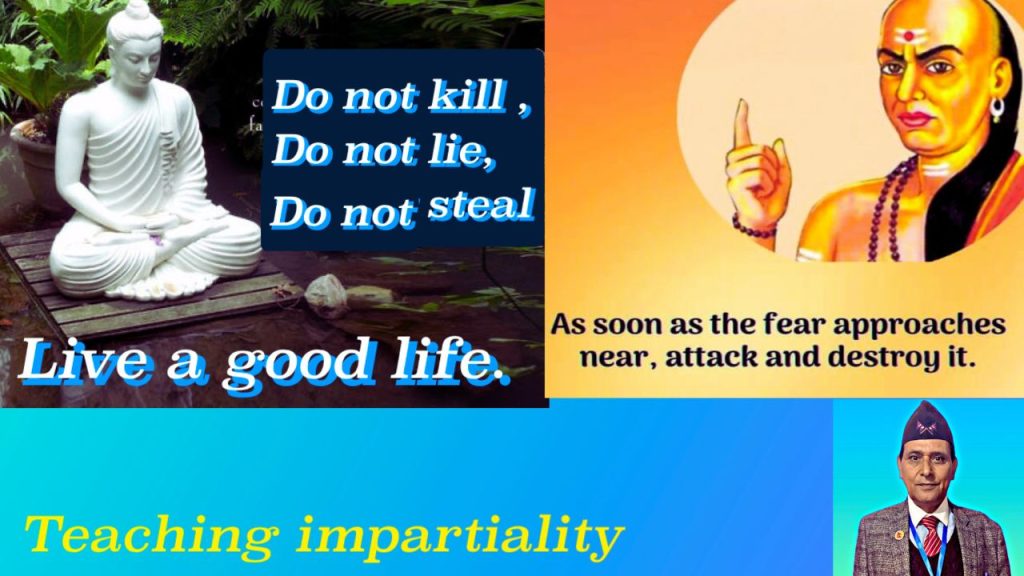
They enable their students to understand that ‘the pen is mightier than the sword’. They enable them to provide information about religion, karma, artha, and moksha. Overall, teachers need Eastern philosophy to become creators of society, aiming for the all-around development of children by connecting the past and present.
Conclusion
Education is a continuous process of learning from birth to death. Learning is endless, and people experience both good and bad types of education. Along with the development of mankind, human consciousness also evolved. The process of learning and teaching education in a systematic way evolved, and various educational philosophies were created. I will analyze these philosophies in detail later. In this article, I have written only a glimpse of the earlier philosophies.
Next Post:Lifelong Learninghttps://knsapkota.com/lifelong-learning/