
गुरु ब्रह्मा गुरु विष्णु गुरु देवो महेश्वरः गुरु साक्षात परब्रह्म तस्मै श्री गुरुवे नमः I bow down to the feet of the Guru, who is like Lord Brahma, Vishnu and Shiva, who is the form of the Supreme Brahman.
Table of Contents
‘Gu’ means darkness, and ‘ru’ means light. Guru is the main source of knowledge. One who removes ignorance and imparts knowledge. Thus, the Guru is the true Brahman. Guru Purnima is celebrated as Veda Vyas Jayanti. The great sage Veda Vyas wrote the Vedas, Vedanta, eighteen Puranas, Upanishads, and contributed greatly to Hindu Nepali culture. These Nepali Hindu texts written in Devanagari script are our guides.
Guru is the source of knowledge.
“Guru” Teacher is a person who imparts knowledge. Such a teacher is called a teacher, lecturer, or professor. Socrates, Plato, and Aristotle were all qualified teachers. Fabel likened the learner to a plant, the teacher to a gardener, and the school to a garden. Rousseau was a naturalist educator. He said that a child is born free, and he should be allowed to learn freely.
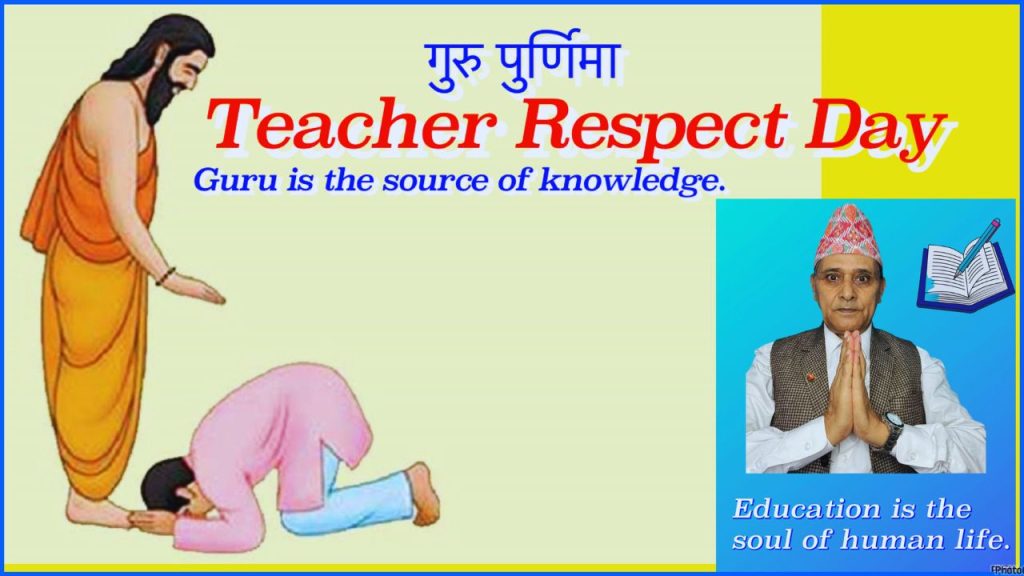
The teacher should act as a guide. America and Australia, which are considered developed and wealthy nations, have not been able to make satisfactory educational reforms despite spending a lot of money. This was published in a thought-provoking article on education in the famous British weekly ‘The Economist’, which was published on October 18, 2007.
Based on this, another study found that Canada, Finland, Japan, Korea, and Singapore achieved excellence according to the measurement system developed by the Organization for Economic Cooperation and Development. The consulting organization examined and presented three important points. First – arranging the most qualified teachers, second – selecting and retraining the most qualified teachers from among the most qualified, and third – providing immediate educational support to students where they lag behind.
If these three points are implemented practically, great improvements will definitely be achieved even with little investment in education. Despite investing heavily in education, Britain, America, and Australia have not been able to achieve the desired improvement, but in countries such as South Korea, Singapore, and Hong Kong, only the best graduates and post-graduates are retrained as teachers, so quality education is available.
The abundance of physical resources and educational materials alone cannot bring about significant changes in teaching and learning unless the people who use those resources are competent.
GURUS (Teachers) are the backbone of the nation
In this context, former President of India Sarvepalli Radhakrishnan has said, ‘Only those with the best minds and brains of the country should be made teachers.’ Similarly, in the words of former President APJ Abdul Kalam, ‘Teachers are the backbone of the nation.’ That is, a developed nation can be built only through qualified and excellent teachers. A hundred years ago, the teachers’ association and community in America had passed a code of conduct to be followed by teachers.
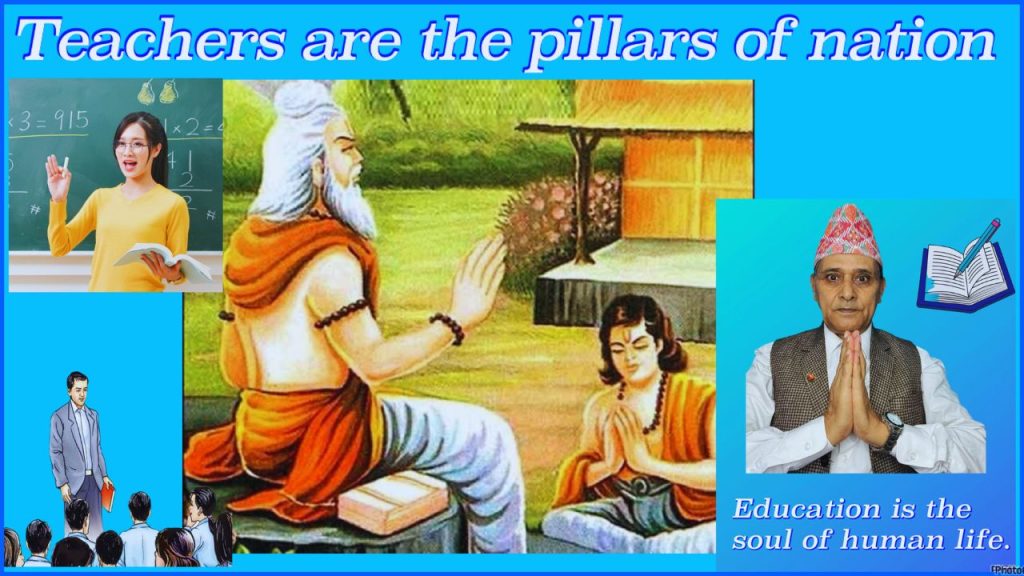
The aim of which was to specify the personal, social, and professional qualities of teachers. Personal qualities are good health, attractive personality, melodious voice, interest and enthusiasm, patience and tolerance, love and sympathy, confidence, morality and character, etc. Social qualities are impartial, a clear speaker, able to maintain human relations, service-active, humorous, able to lead, and knowledge of the community, etc.
The most important professional qualities are: high knowledge of the subject, teaching skills, knowledge of child psychology, knowledge of teaching methods, methods and technology, sense of responsibility, curiosity and studiousness, research, etc. In summary, the West has 100% accepted our established values and ideals.
Nepali Hindu scriptures discuss two great gurus, one is the god Guru Brihaspati and the other is the demon Guru Shukracharya. Teachers are the builders of the country, but teachers can also become the destroyers. Therefore, on this day of Guru Punima, we should think about what kind of guru we should worship and what kind of guru we should despise.
The meaning of calling a guru Brahma is to develop the creative power in the all-round development of children and to care, supervise, and nurture like Vishnu and to destroy ignorance, evil ways, and evil thoughts like Maheshwar. Just as delicious food cannot be prepared without a skilled cook, good education is not possible without a good, qualified teacher.
Guru Purnima is a festival that is considered a big and holy day for the followers of the Vedic Sanatan religion. Vedic and Hindus celebrate the birth anniversary of Veda Vyasa, the author of the Mahabharata, Shrimad Bhagavat, Athar Puranas, and Vishnu Sahasranama and the four parts of the Apaurusheya Vedas, as Guru Purnima. On that day, it is customary for students to offer garlands to the Guru and receive a tika from him.
Towards the end of the Dwapara Yuga, before the Kauravas and Pandavas, Vyasa was born on the same day as the son of sage Parashara and the daughter of the fisherman Matsyagandha, on the Uttarayan Nakshatrapunirma. Vyasa is considered the greatest Guru because he taught the Vedas to all the sages, including his son Shukadev, and on that day, the Guru who taught him is honored and remembered. In Sanskrit, ‘Gu’ means darkness, and ‘Ru’ means to destroy.
Gurus who teach their disciples the knowledge of light and remove the darkness of ignorance in them are considered to be Brahma, Vishnu, Maheshwar, and the Supreme Brahma. According to Nepali and Hindu beliefs, teachers who teach 64 arts including music, give Gayatri-Diksha Mantra-Veda Mantra, and people who are mature in age, intelligence, strength and experience are also considered Gurus, while father, mother, maternal uncle, father-in-law, maternal grandfather, grandfather, Brahmin and uncle are also considered Gurus.
Earlier, it was customary to study in Gurukuls after observing Brahmacharya until the age of 25. It is mentioned in the scriptures that in the Treta Yuga, Maryada Purushottam Rama, along with his brother and in the Dwapara era, Lord Shri Krishna also studied in Gurukuls. In the past, Gurus were scholars, but students were also humble, Guru-devotional, and knowledge-seeking. It has been said that the recognition of Guru is not achieved by others
The teachers from ancient times to the present
Since Gautama Buddha gave his first sermon on this day, Buddhists celebrate this day as Dharma Chakra Pravartan Diwas.
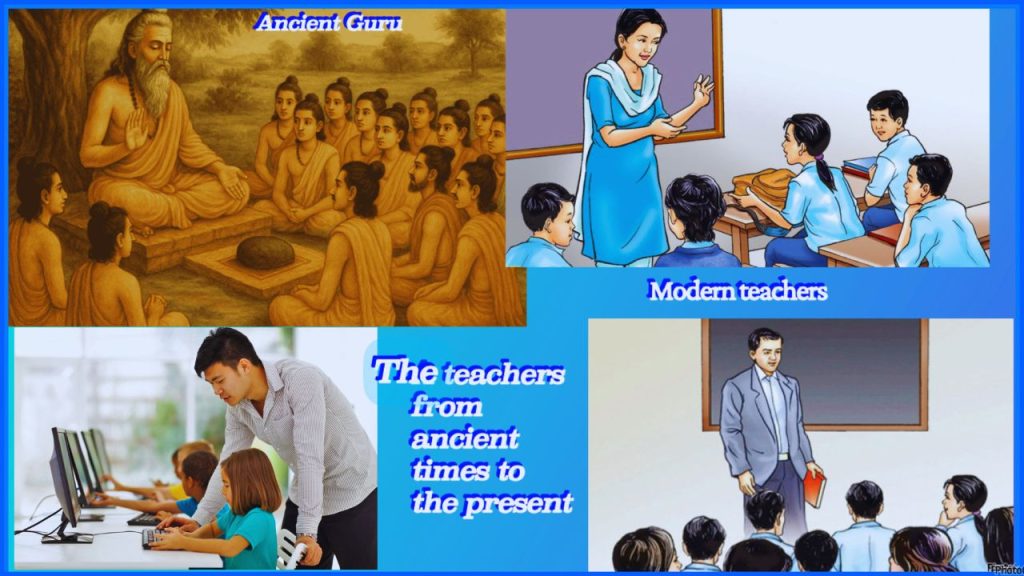
The source of our knowledge is the Guru. From ancient times to the present, various methods of acquiring knowledge from Gurus have been used. From the tradition of acquiring knowledge by staying at the Guru’s house, modern schools have also come to provide education online.
Conclusion
Guru Samman Diwas (Teachers Respect Day) has been celebrated since ancient times. The followers of Vedic Sanatan Dharma celebrate the birth anniversary of Rishi Guru Vyas, the author of the Vedas, on Guru Purnima. Today, following this, Teacher’s Day is celebrated all over the world. We should always respect the great teachers who have removed our ignorance and awakened the light of knowledge. Special focus is given to the day of Guru Purnima every year.
Next post:Quality Education