
In this article, I have tried to cover the origin and principle of yoga, the father of yoga, sage Patanjali, who formulated the sutra of yoga rules, and the details of yoga, Ashtanga yoga, the importance and benefits of yoga. If you are interested in taking free yoga training, check out my YouTube channel named KN SAPKOTA.
According to the holy “Vedas”,( The truth cosmology),yoga is the practice of physical exercise in a peaceful manner to connect the soul and mind with the divine. Lord Shiva is considered the God of Yoga. Shiva was the originator of yoga so he is called “Aadi yogi”. with the passage of time, Maharishi ”Patanjali”created the yoga philosophy and codified it. Maharshi Patanjali’s contribution to yoga lies not only in the consolidation of existing knowledge but also in his systematic approach to yoga practice.
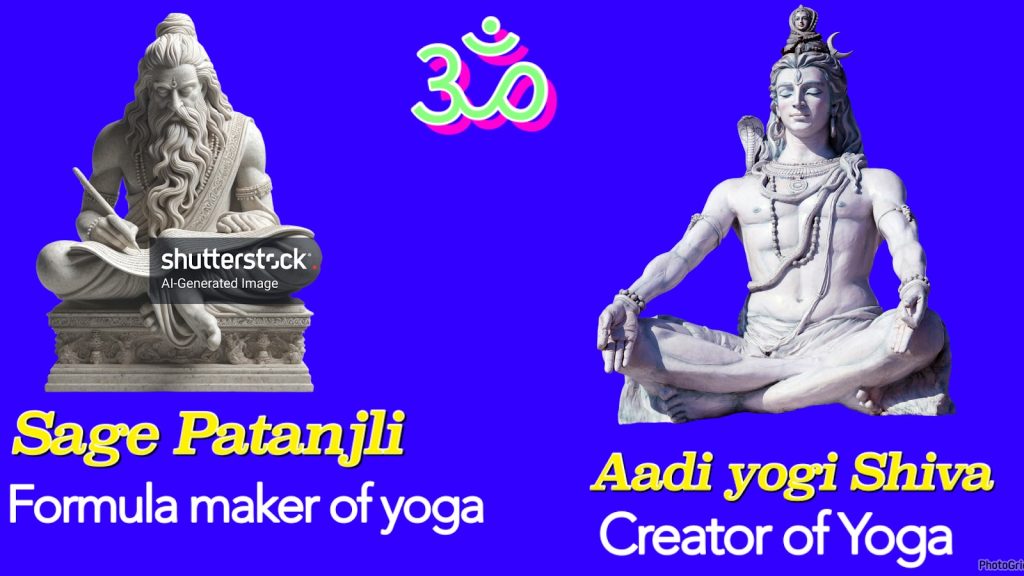
He outlined an eightfold path known as Ashtanga Yoga, which serves as a practical guide for practitioners to achieve spiritual liberation.According to Patanjali’s Yoga Sutras, the ultimate goal of yoga is to reach liberation or ultimate freedom (kaivalya). This is the experience of one’s inner being or “soul” (purusha). The individual is then freed from the chains of cause and effect (karma) that bind us to continuous rebirth.
Table of Contents
Maharishi Patanjali came from heaven.
One version states that in order to teach yoga on earth, he descended from heaven as a small serpent, into the inverted planes (known as Anjali) of his virgin mother, Gonika, who washerselfa powerful yogini.Patanjali regularized and codified yoga and created the philosophy of yoga, which is still popular all over the world.The word “yoga” is derived from the Sanskrit root “Yuj”means to join or to unite as per yogic scriptures.The practice of yoga leads to the union of individual consciousness with the universal consciousness indicating the perfect harmony between the mind and the body.

.7 thousand years ago yoga had been originated in Bharat Varsa (Indus Valley) Bharat Varsa is located south of the great Himalayan mountain range and was known as a civilized land of sacred places. During the colonial rule of the British, French and Portuguese, it was called the Indus Valley. At present, it is divided into various countries such as Nepal, India, Thailand, Pakistan, Afghanistan, Burma, Bangladesh, Bhutan, etc. (South Asian countries)
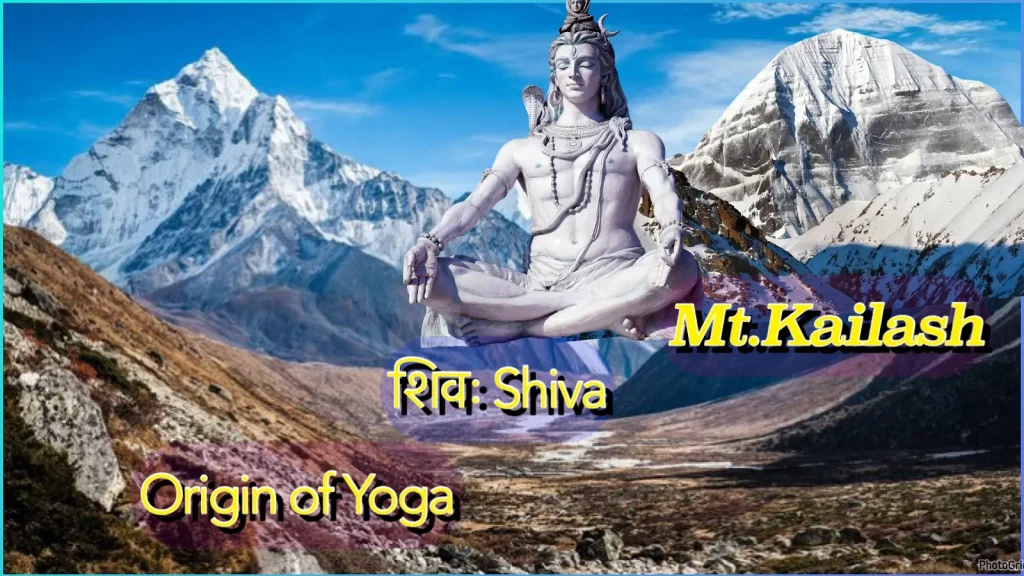
This holy land is an example of the gods and goddesses following the rules of yoga and meditation and inspiring mankind to follow yoga meditation in a disciplined manner, thus providing the art of living a life of happiness and peace by walking on the path of the real truth.According to yoga philosophy, a person who practices yoga regularly and consistently, according to the rules and regulations, has a happy and successful life.
The statements of sages and related bodies are proof.
”Saint Manu” Says-
“भोगो न भुक्त्वा वयमेवभुक्ताश्तपो न तप्तंवयमेव तप्ताः।
कालो न यातोवयमेवयातातृष्णा न जिर्णावयमेव जीर्णा॥
It means that we don’t experience the pleasure or pain,but things experience us.The Devotion does not devote,we devote ourselves,time does not end,we merge into time.Desires don’t destroy,we get destroyed.We never get satisfaction after attaining something,desires become more and more strong in turn.
“अष्टांग योग” Ashtanga Yoga is a classical yoga practice developed by Maharishi Patanjali, which he codified in his Yoga Sutras. The practice is known as the “Eight branchs of Yoga” and is considered a disciplined path to spiritual enlightenment.
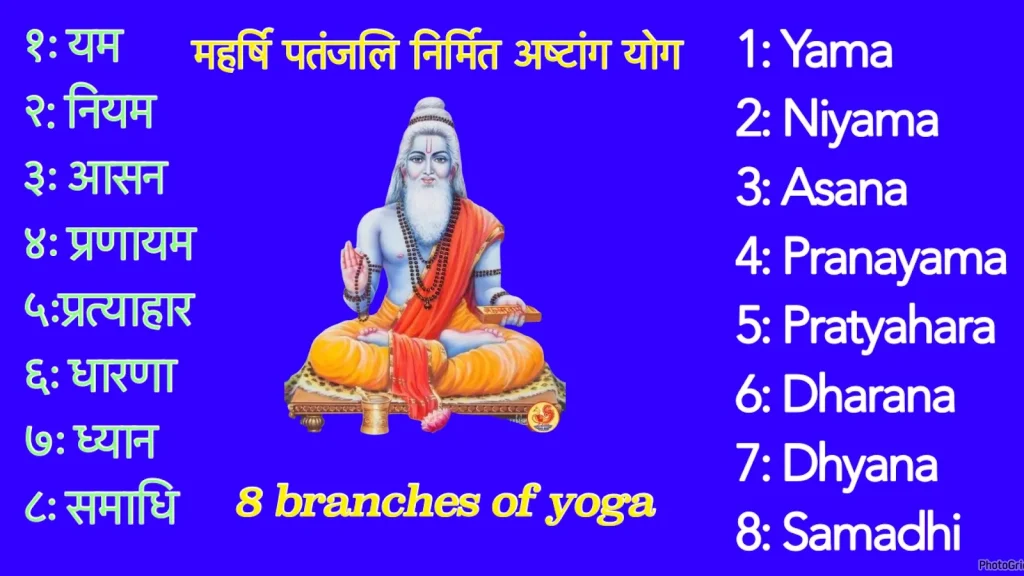
8 Branches of Yoga
The eight branches of yoga are as follows.
1: यमः“Yama” is the first pillar of Ashtanga Yoga. Yama is the state of morality. Its purpose is to awaken oneself in moral power. Morality is the first foundation of a successful life.Yama: Moral restraints, such as non-violence, truthfulness, and non-stealing
2: नियमःNiyama: Disciplines, such as self-study and it means five personal ethics. These include शौचः saucha, which means purification of body and mind, सन्तोषः santos means being content and happy,तपः tapa, which means self-discipline,स्वाध्यायः svadhyaya, which means self-reflection, and ईश्वर प्रणिधानः ishvara pranidhana, which means having complete faith in God..
3: आसनःAsana:That is the seat in which one can sit steadily and comfortably. That seat is attained by the relaxation of effort and by concentrating the mind on the infinite (God). The attainment of that seat does not suffer from the conflicts of cold, heat, hunger, thirst, joy, sadness, etc.
4प्रणायमःPranayama: Control of breath and energy Pranayama is the rhythmic movement of breathing after mastering the asana. There are 3 stages of pranayama (puraka, kumbhaka and rechaka). Taking in a breath is called puraka, holding it in is called kumbhaka and exhaling it out is called rechaka. This process should be done slowly and by following the rules of yoga practice.
5:प्रत्याहार Prtyahara: Withdrawal of the senses is pratyahara . To completely free the senses from desires and passions. Pratyahara is the practice of controlling the external actions of the senses and merging them with the mind is real pratyahara. It is said that the senses of a yogi remain completely under his control. The five sadhanas mentioned above are called external sadhanas and the remaining three sadhanas are called internal sadhanas. Dharana, meditation and samadhi are internal sadhanas.
6:घारणाः Dharana: Concentration Keeping the mind under control is dharna. Pulling the mind and keeping it in a special place is dharna. In other words, dharna can also be called patience. Humans have various desires and aspirations, some of which may be wrong. A yogi has the ability to use the truth only by choosing it well and abandoning the untruth.
7: ध्यानः Dhyana: Meditation :- Concentration of the mind on the object on which it is focused is meditation. Meditation is the state of the mind remaining in the same flow, even for a moment, without being distracted. Without a concentrated mind, no work can be done successfully, such as reading, writing, playing, speaking, listening to songs, etc. Therefore, a true yogi practices meditation-based yoga and makes life meaningful and successful.
8: समाधिःSamadhi: Blissful state of union between subject and object When the mind becomes devoid of the form of the thing being meditated upon and only meditation is experienced, that is Samadhi. This is the ultimate goal of Ashtanga Yoga. This point can be reached only after practicing all the methods in a disciplined manner.
Benefits of Ashtanga Yoga
Ashtanga Yoga is a holistic practice that aims to improve physical, mental, and spiritual well-being. It involves a series of asanas, synchronized breathing, and meditation elements.
The purpose of Ashtanga Yoga is to guide practitioners towards self-knowledge, liberation, and the end of personal suffering.